

Newsletter no. 7
Nature-based Solutions for Demonstrating Climate-Resilient Critical Infrastructure
IBM Research Contribution to NATURE-DEMO
Partner Spotlight
Climate change is no longer a distant risk; it is an operational reality for the critical infrastructure that underpins modern European society. Roads wash out in flash floods, railway embankments fail under record rainfall, and energy substations buckle under extreme heat. Predicting where and how severely these hazards will strike, and then identifying the nature-based solutions best positioned to mitigate them, is precisely the challenge NATURE-DEMO is designed to address.
IBM Research brings to this consortium a distinctive set of capabilities built around geospatial AI, artificial intelligence specifically developed to understand the Earth’s climate, and the way extreme events unfold across it.
From Space to Risk Score: IBM’s Geospatial AI Toolkit
IBM Research has spent the last several years building, training, and open-sourcing a family of foundation models for Earth observation. Foundation models learn general-purpose representations of the world from vast quantities of data, and can then be fine-tuned rapidly for specific tasks, much as a large language model can be adapted for a new domain with relatively little labelled data.
The family has two flagship models. The first one, Prithvi, developed jointly with NASA, is a vision transformer trained on multi-temporal satellite imagery from the NASA Harmonized Landsat Sentinel (HLS) archive, which combines NASA Landsat and ESA Copernicus Sentinel observations. Because it is trained on temporal sequences rather than single snapshots, it excels at detecting change: deforestation, post-flood damage, crop stress, wildfire burn scars. The most recent generation, Prithvi-EO-2.0, extends this capability with improved geographic generalisation. TerraMind, developed jointly with ESA (released in 2025), is the second flagship model, designed for multi-modal data: it introduces generative and any-to-any reasoning, enabling the model to perform “thinking across modalities” (optical imagery, radar, elevation maps) without manual tokenisation of each input type.
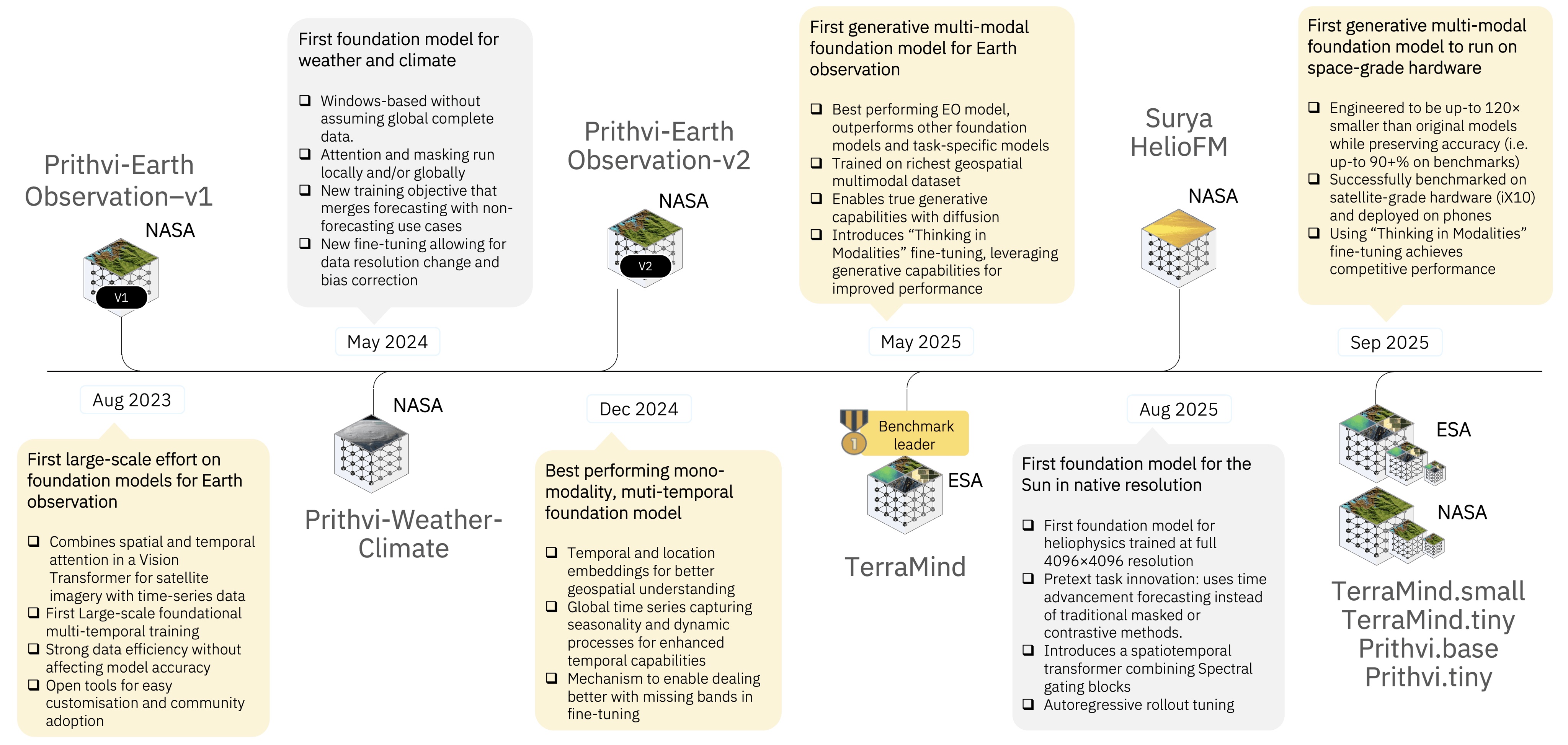
Evolution of IBM’s geospatial AI foundation model family, from Prithvi (2023) through to TerraMind (2025). Source: IBM Research.
Alongside the geospatial models, IBM has developed Prithvi-WxC, the first foundation model for weather and climate forecasting. These tools are not proprietary: all models and datasets are released under Apache 2.0 licences on Hugging Face, ensuring that the scientific community, including the NATURE-DEMO consortium, can build upon them freely.
The quality and impact of this work has been recognised beyond the research community. The Prithvi model family was awarded a NASA Group Achievement Award, with NASA estimating that the models have generated substantial economic value by lowering the barriers for scientists worldwide to access and interpret archival satellite data. The models have attracted widespread adoption across the research community, with hundreds of thousands of downloads and citations in hundreds of peer-reviewed studies.
Mapping Extreme Events: Floods and Wildfires
One of the most direct contributions IBM Research has made to the broader challenge of climate-related disaster monitoring is the release of ImpactMesh, the first global, multi-modal, multi-temporal dataset covering extreme flood and wildfire events over the past decade. Assembled in collaboration with ESA, ImpactMesh combines optical imagery, Synthetic Aperture Radar (SAR) data, and terrain elevation maps for each event, all sourced from Copernicus Sentinel satellites.
This multi-modal design matters in practice: during an active wildfire or a flooding event, smoke and storm clouds routinely obscure optical sensors. SAR is unaffected by cloud cover, and elevation data provides the physical context needed to understand drainage patterns and burn susceptibility. Fine-tuning TerraMind on ImpactMesh has produced measurably more accurate burn-scar maps than those produced from optical imagery alone, which matters when the outputs feed into emergency response and infrastructure damage assessment.

Global coverage of the ImpactMesh dataset, comprising satellite observations of extreme flood and wildfire events over the past decade. Source: IBM Research / ESA.
A practical illustration of why this matters: during the 2022 Queensland floods in Australia, persistent cloud cover rendered conventional optical satellite imagery largely unusable at the height of the event. Radar data from the ImpactMesh dataset allowed the flooded extent to be mapped reliably regardless, demonstrating the real operational value of a multi-modal approach in the conditions that matter most.
To lower the barrier to entry for other researchers, IBM has also released TerraKit, an open-source toolkit for assembling AI-ready geospatial datasets from satellite data archives.
Bringing It Together: Climate Tools and the Decision Support Platform
IBM Research leads Work Package 2 of NATURE-DEMO, contributing both climate hazard characterisation tools and technical expertise to the project’s central decision-making infrastructure.
On the hazard characterisation side, IBM has developed tooling that processes EURO-CORDEX1 regional climate model outputs into the indices the platform needs, covering temperature extremes, precipitation, drought, snow, and humidity, across historical and future scenarios through to 2100. This gives the full consortium a shared, reproducible picture of how climate conditions are projected to shift at each demonstration site.
The Decision Support Platform being developed by the University of Rostock within Work Package 2 will incorporate climatic hazard characterisation within a structured risk assessment framework following the IPCC approach2, to evaluate current and projected climate risk and identify suitable nature-based interventions for European critical infrastructure. IBM Research provides the geospatial AI models, processed climate data, and technical support that make the platform’s hazard and risk estimates credible, working alongside consortium partners who bring complementary skills in hydrology, structural monitoring, and infrastructure engineering.
The aspiration of the platform is to provide infrastructure managers with a clear picture of their climate risk exposure, current and projected, and to help them identify and prioritise nature-based solutions. A transport authority concerned about flooding on a key rail corridor, or a water utility managing drought stress on an ageing dam, can use the platform to determine which hazards pose the greatest risk to their assets, which interventions would reduce that risk most effectively, and whether the investment is justified.
The platform is being developed and tested against five demonstration sites spread across Europe, covering both transport and energy infrastructure. By grounding the tool in real sites and real infrastructure challenges, the consortium can ensure that what gets built actually works for the practitioners who will use it.
1 Jacob, D. et al. (2014). EURO-CORDEX: new high-resolution climate change projections for European impact research. Regional Environmental Change 14, 563–578. doi:10.1007/s10113-013-0499-2. www.euro-cordex.net.
2 IPCC (2022). Climate Change 2022: Impacts, Adaptation and Vulnerability. Contribution of Working Group II to the Sixth Assessment Report. Cambridge University Press. doi:10.1017/9781009325844.
About IBM Research
IBM Research is one of the world’s largest corporate research organisations, with laboratories across Europe, the Americas, Africa, and Asia. IBM Research Europe is the consortium partner leading Work Package 2 of NATURE-DEMO, building on sustained investment in climate and Earth observation science. IBM’s models and datasets have been widely adopted by the research community, with hundreds of thousands of downloads and citations in hundreds of peer-reviewed studies. NASA has estimated that the Prithvi model family alone has generated approximately $36 million in economic value by reducing barriers to accessing and interpreting archival satellite data.
IBM is committed to open science, and its contributions to NATURE-DEMO follow the same principle: models, tools, and data are made openly available wherever possible, consistent with the project’s mission to mainstream nature-based solutions across European critical infrastructure planning.
Further reading
- IBM Research Earth observation leadership: research.ibm.com/blog/earth-observation-leadership
- ImpactMesh and flood/wildfire mapping: research.ibm.com/blog/geospatial-flood-and-wildfire-mapping
- NASA Group Achievement Award for Prithvi: research.ibm.com/blog/nasa-award-ibm-foundation-model
NATURE-DEMO Partners






















Stay tuned!