
We are pleased to invite you to an important upcoming seminar that will explore the future of climate resilience, infrastructure protection, and disaster risk management.
Event Details:
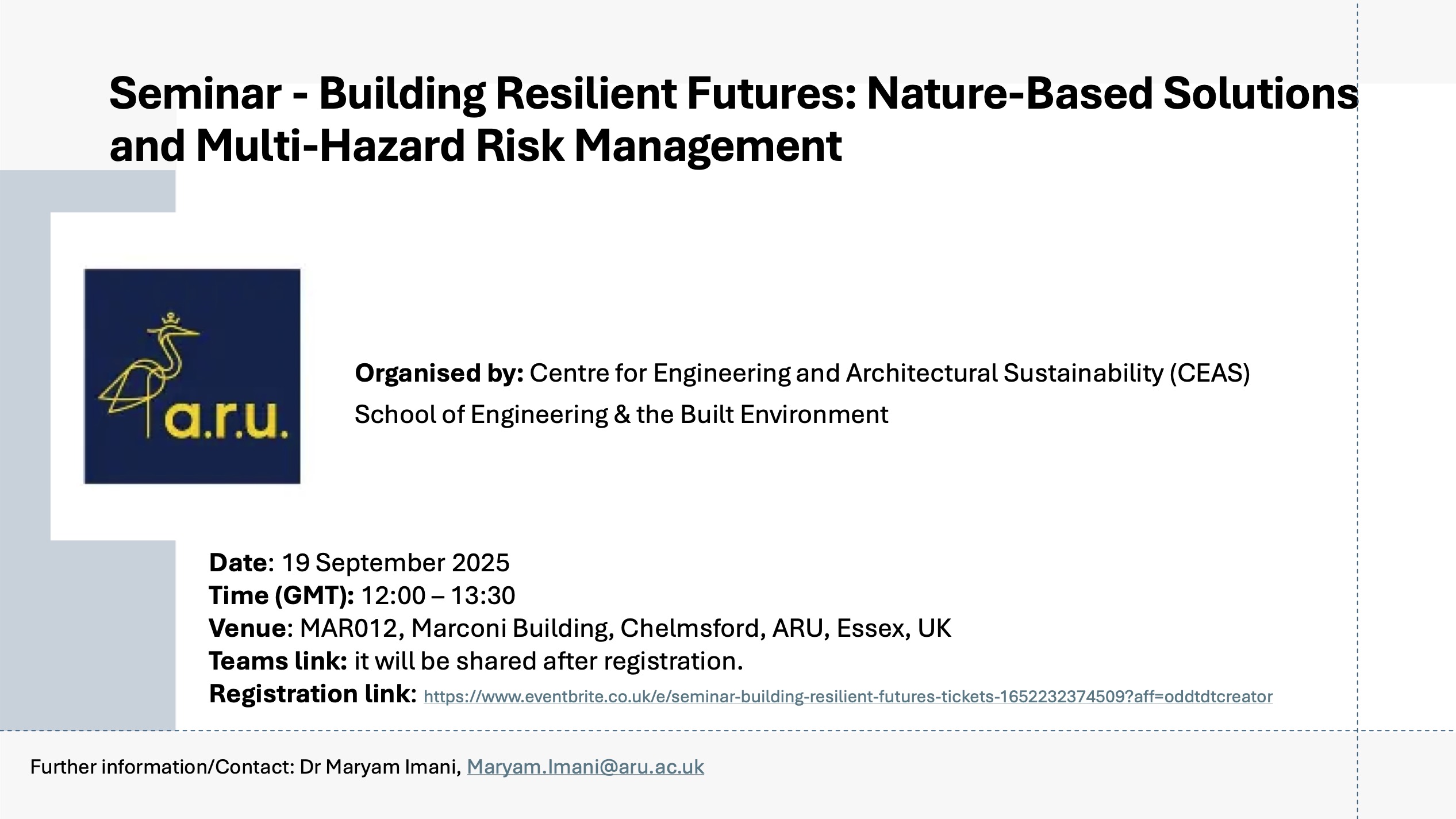
Date: 19 September 2025
Time: 12:00 – 13:30 GMT
Venue: MAR012, Marconi Building, Chelmsford Campus, Anglia Ruskin University (ARU), Essex, UK
Format: Hybrid (in-person & online)
Registration: Online participants need to register via the link below to receive a Microsoft Teams access link: Eventbrite Registration
Further information / Contact: Dr. Maryam Imani – Maryam.Imani@aru.ac.uk
This hybrid seminar is an exciting opportunity to hear from experts who are at the forefront of developing innovative solutions for enhancing the resilience of infrastructure and communities. Dr. Mohamed Eldessouki, Coordinator of the NATURE-DEMO project, and Dr. Mariantonietta Morga, Senior Lecturer in Civil Engineering at ARU, will share their groundbreaking research and insights.
Talk 1 – Nature-Based Solutions for Climate-Resilient Infrastructure
Presented by Dr. Mohamed Eldessouki, this talk will focus on the NATURE-DEMO project, which integrates nature-based solutions (NbS) into infrastructure planning. Dr. Eldessouki will explain how the project is creating a digital decision-support platform that incorporates climate projections, asset exposure, and NbS catalogues. The project is already being tested at real-world sites across Europe and is poised to scale to more locations, providing a roadmap for building sustainable, climate-resilient infrastructure.
Dr. Eldessouki’s extensive experience in digital innovation, smart materials, and sustainability makes him a leading expert in the field. His work with the Digital Innovation Centre and contributions to the European smart manufacturing ecosystem will offer valuable perspectives on future-ready infrastructure strategies.
Talk 2 – Multi-Hazard and Risk-Informed System for Enhanced Local and Regional Disaster Risk Management
In Dr. Mariantonietta Morga’s presentation, the focus will be on the MEDiate project, which has developed a multi-hazard decision-support system (DSS) for disaster risk management. This innovative tool is designed to help local authorities and businesses navigate complex risk scenarios, considering not only climate change but also evolving vulnerabilities like aging infrastructure and demographic shifts.
The MEDiate system has been tested in several European regions, including Oslo, Nice, Essex, and Iceland, and it offers a service-oriented approach to building adaptive resilience strategies.
Why Should You Attend?
This seminar is perfect for professionals and stakeholders involved in infrastructure development, climate resilience, and disaster management, including:
-
Local and regional authorities
-
Infrastructure owners and planners
-
Environmental agencies
-
Researchers and students in sustainability and engineering fields
By attending, you will gain valuable knowledge on how nature-based solutions can be integrated into infrastructure projects, how to manage multi-hazard risks, and how digital tools are transforming the landscape of disaster risk management.
Don’t miss this chance to engage with industry leaders and learn how we can all contribute to building a more resilient and sustainable future.
Register Now!
To secure your spot at this insightful event, click here to register.
For further information, please contact Dr. Maryam Imani at Maryam.Imani@aru.ac.uk.
Related
-
Bioswales: green channels that slow the flow
Bioswales are a linear rainwater run-off retention system designed as a shallow, gently sloping non-concrete channel (allowing for water infiltration). This system basically captures, retains and slowly releases the water run-off and direct rainwater into a conventional piping drainage system and/or the air (evapotranspiration) and soil (infiltration) media.
-
Rain gardens: turning autumn rain into an ally
Autumn brings long spells of rain, and with them come flooded streets, blocked drains and overloaded sewers. In a city covered by asphalt, rooftops and paving, rainwater has nowhere to soak in, so it rushes towards the drainage network all at once. Rain gardens offer a simple, attractive and evidence-based alternative.
-
NATURE-DEMO Featured at Tag der Schiene 2026 by DZSF
On September 19–20, 2026, the German Centre for Rail Traffic Research at the Federal Railway Authority (DZSF) represented the NATURE-DEMO project during Tag der Schiene 2026 (Railway Day), a major public outreach event dedicated to the future of rail transport.
-
NATURE-DEMO Scientific Frameworks Shared at Erasmus+ CRESC Summer School in Ostrava
From August 24 to 28, 2026, the Faculty of Safety Engineering at VŠB – Technical University of Ostrava (Czech Republic) hosted the Erasmus+ Blended Intensive Programme (BIP) International Summer School on Climate-Resilient Critical Infrastructure (CRESC).
-
NATURE-DEMO Newsletter no. 9
Stay updated on how NATURE-DEMO is strengthening European infrastructure resilience against climate hazards. Explore our latest quarterly newsletters to discover key project milestones, field implementation updates across our demo sites, newly published scientific research, and upcoming events.