
Late October is when fallen leaves clog street gutters and autumn downpours turn roads into streams. Conventional drainage is built to move water away as fast as possible, through pipes and concrete channels. Bioswales take the opposite approach: they slow the water down, clean it and let the ground absorb it.
What is a bioswale?
A bioswale is a shallow, gently sloping vegetated channel, usually built along one or both sides of a road, a car park or a path. Unlike a concrete ditch, its bed is permeable. Runoff that enters it moves slowly along the channel, soaks into the soil, evaporates through the plants or, during heavy events, flows gently on to the drainage network.
A typical bioswale has a few simple parts:
- a shallow trench with a gentle slope, often dug along the contour of the land;
- side slopes that guide water into the channel;
- grasses, shrubs or other plants that tolerate both drought and temporary waterlogging;
- optionally, an infiltration basin at the end, or a low berm on the downhill side built from the excavated soil.
Why it matters
- Less flooding. By holding and slowing runoff, bioswales reduce peak flows and the pressure on sewer systems.
- Cleaner water. Soil and vegetation filter pollutants washed off roads and car parks before they reach rivers or groundwater.
- Drought resilience. Infiltrated water recharges groundwater and keeps surrounding soils moist for longer.
- Erosion control. Slower water and stable roots protect road verges and slopes.
- Cooler streets and more wildlife. Vegetated corridors reduce heat and provide habitat for insects and small animals.
Evidence from practice
Metropolitan City of Milan, Italy. The water utility Gruppo CAP is implementing Integrated Urban Sponge Plans across 32 municipalities, with 90 planned interventions. They combine vegetated ditches with rain gardens, detention basins, drainage trenches and permeable pavements. Together, the projects add 31,019 m² of sustainable drainage surfaces and 6,314 m³ of water storage capacity.
University of California, Davis, USA. Researchers monitored an experimental bioswale with an engineered soil mix for eight years. It kept working at full design capacity and removed considerably more runoff and pollutants than a comparable bioswale built on native soil, while also supporting healthy tree growth.
Riga, Latvia. A bioswale system was built in the car park of a shopping centre for about €50,000, showing that the approach also works for private commercial sites.
What does it cost?
Building a bioswale costs on average about €70 per m², with maintenance of around €0.52 per m² per year in the EU. Capital costs are usually comparable to conventional drainage. Earlier estimates per connected m² put bioswales at about €5.17, against €8.97 for conventional sewer systems. Maintenance is slightly higher than for pipes, but much of it overlaps with routine green-space care, and the wider benefits, from cleaner water to cooler streets, accrue to society for decades.
NATURE-DEMO: nature as infrastructure
Bioswales are one of the nature-based solutions catalogued by NATURE-DEMO, a research and innovation project funded by the European Union under Horizon Europe. The project brings together 23 organisations from 14 countries to test how nature can protect roads, railways, energy networks and settlements against floods, droughts, landslides and wildfires.
Sources

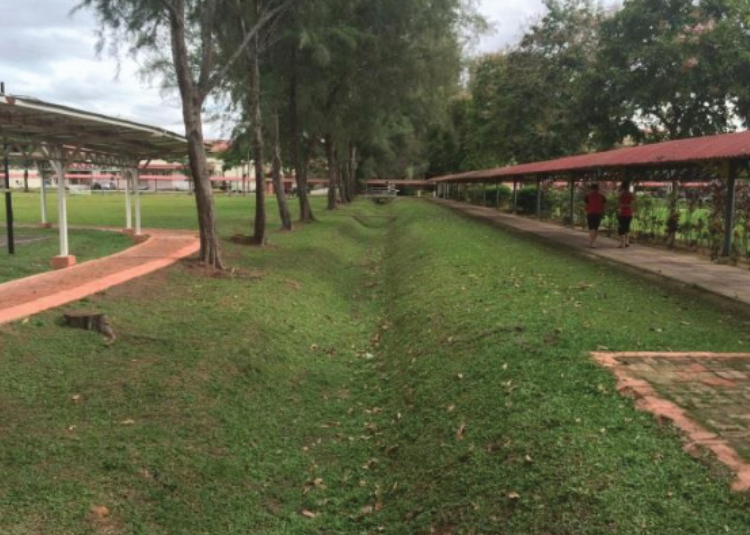
Constructed Swale in USM Engineering Campus
Image Credit: [Ngai Weng Chan/Universiti Sains Malaysia], [2020]. Used with permission
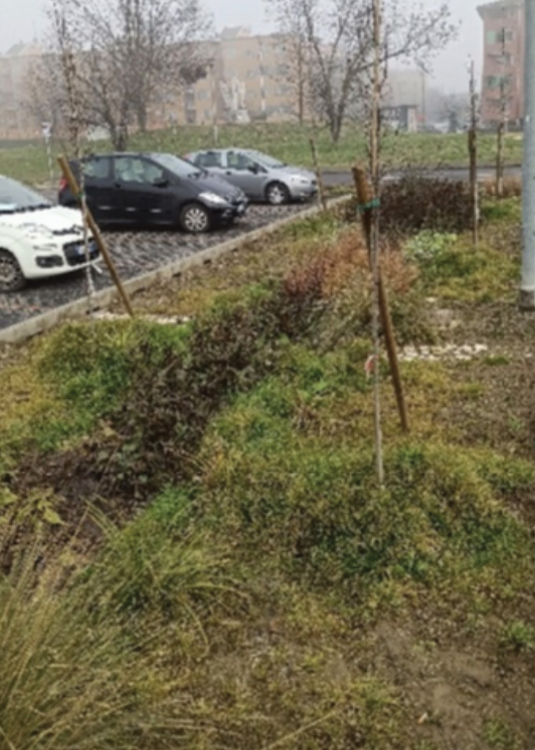
Bioswale
Image Credit: [IRIDRA], [2022], Used with permission
Related
-
Rain gardens: turning autumn rain into an ally
Autumn brings long spells of rain, and with them come flooded streets, blocked drains and overloaded sewers. In a city covered by asphalt, rooftops and paving, rainwater has nowhere to soak in, so it rushes towards the drainage network all at once. Rain gardens offer a simple, attractive and evidence-based alternative.