
Dr. Mohamed Eldessouki, Founder and Director of Digital Innovation Centre (DigInnoCent s.r.o.) and a key coordinating partner in the NATURE-DEMO project, delivered a substantial keynote speech at the recent IEEE International Conference on Distributed Computing Systems (ICDCS). During his address, Dr. Eldessouki introduced and prominently presented the NATURE-DEMO project.
His presentation, titled "Distributed Intelligence for Planetary Resilience: From Smart Transport to Climate-Adaptive Infrastructure," engaged a global audience of researchers, developers, and users. It explored how distributed AI systems and cutting-edge edge computing are tackling pressing planetary-scale challenges.
The keynote detailed distributed AI systems addressing these planetary challenges through concrete European projects. It demonstrated how edge computing facilitates intelligent decision-making by examining the CloudMATE (structural health monitoring), SETO (smart transport enforcement), and, specifically, NATURE-DEMO (climate-resilient infrastructure via Nature-based Solutions - NbS) projects. The presentation also addressed critical distributed systems challenges, such as real-time data processing over narrow-band networks, edge-cloud load balancing for AI analytics, and maintaining stakeholder visibility. Practical implementations illustrated novel edge computing architectures, allowing intelligent processing at the sensor level and transmitting essential data to cloud systems for digital twin creation and AI-driven decisions.
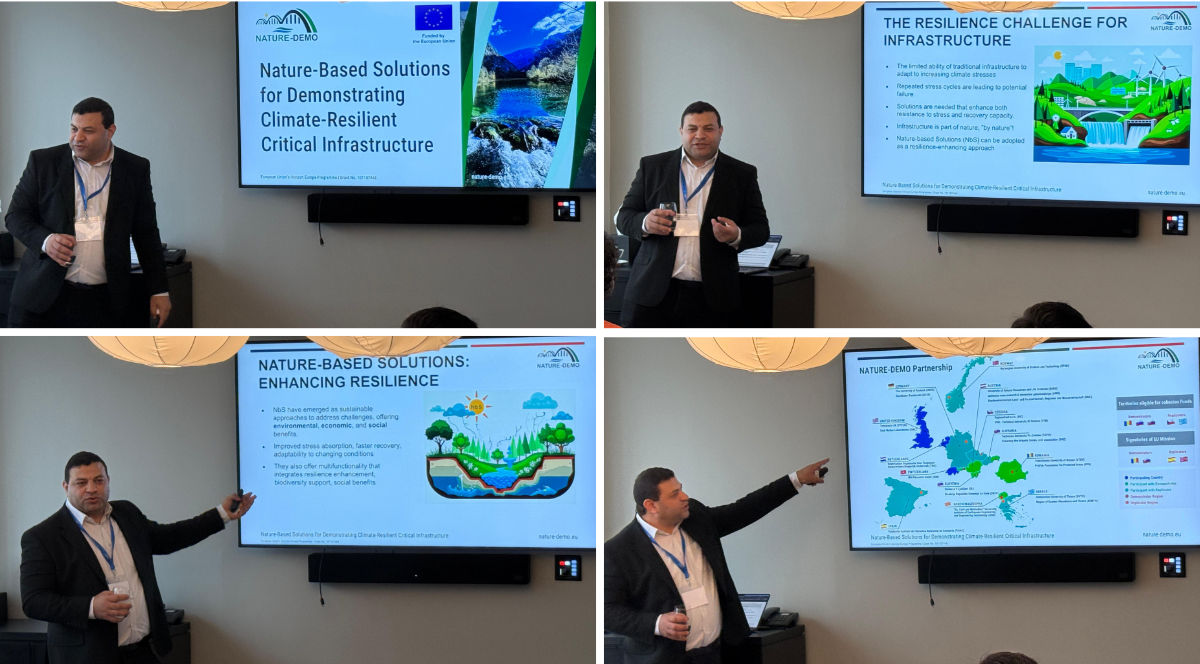
Dr. Eldessouki's contribution to the IEEE ICDCS Conference provided a valuable platform for the NATURE-DEMO project. He not only highlighted the technical ingenuity of our approach but also emphasized the commitment to mainstreaming Nature-based Solutions as a fundamental element of future climate-adaptive infrastructure. His insights underscored how our distributed intelligence framework is essential for monitoring NbS effectiveness and integrating them into robust climate resilience strategies.
Dr. Eldessouki's contribution and his advocacy for the NATURE-DEMO project are highly valued. His vision and leadership continue to guide our team's efforts toward building a more resilient and sustainable planet.
Related
-
NATURE-DEMO Research on Infrastructure Resilience and Climate Hazards Presented at ICONHIC 2026
The presentation highlighted how the catalogue can support the identification, selection, and implementation of NbS for climate resilience, sustainable infrastructure, and adaptation to natural hazards. It also provided an opportunity to discuss how NbS can be transferred into practical applications across different environments and communities.
-
NATURE-DEMO NbS Catalogue Presented at the University of Huddersfield
The presentation highlighted how the catalogue can support the identification, selection, and implementation of NbS for climate resilience, sustainable infrastructure, and adaptation to natural hazards. It also provided an opportunity to discuss how NbS can be transferred into practical applications across different environments and communities.
-
NATURE-DEMO insights on NbS compatibility shared at ESREL 2026
The NATURE-DEMO project was included in the technical program of the European Safety and Reliability Conference (ESREL 2026), held in Braga, Portugal.
-
Nature-based Solutions and Infrastructure Research Showcased at GNP 2026, Budva
A delegation from our project partner, the Institute of Earthquake Engineering and Engineering Seismology (UKIM-IZIIS), participated in the 10th International Conference "Civil Engineering – Science and Practice" (GNP 2026), held from 4 to 7 March 2026 in Budva, Montenegro, and organised by the University of Montenegro.
-
NATURE-DEMO Newsletter no. 8
Our May 2026 newsletter is packed with updates on our efforts to advance nature-based solutions (NbS) for critical infrastructure. As the NATURE-DEMO project reaches its two-year milestone, we reflect on a period of intense collaboration and scientific innovation. With the successful completion of the first three Work Packages (WPs) on April 30th, the project has transitioned from a phase of digital and conceptual framework development into the real-world deployment phase.