
Autumn brings long spells of rain, and with them come flooded streets, blocked drains and overloaded sewers. In a city covered by asphalt, rooftops and paving, rainwater has nowhere to soak in, so it rushes towards the drainage network all at once. Rain gardens offer a simple, attractive and evidence-based alternative.
What is a rain garden?
A rain garden is a shallow vegetated depression placed next to an impervious surface such as a roof, a driveway, a car park or a pavement. During rainfall, runoff collects in the depression instead of flowing into the sewer.
Beneath the plants lies a layered, porous soil mix that lets water infiltrate slowly and filters it on the way. The vegetation consists of native species that tolerate both short periods of waterlogging and dry spells. Hybrid designs can also route the water to a tank or cistern, so it can be reused for irrigation or toilet flushing.
Why it matters
- Less local flooding. By holding water at the source, rain gardens reduce peak flows into the sewer system and help protect streets, homes and other infrastructure.
- Cleaner water. Soil and roots can remove up to 90% of nutrients and chemicals and up to 80% of sediments before the water reaches groundwater or streams.
- A buffer against drought. Infiltrated water recharges groundwater and keeps soils moist for longer in summer.
- Cooler neighbourhoods. Vegetation and evapotranspiration help reduce the urban heat island effect.
- More biodiversity. Flowering plants provide food and shelter for bees, butterflies and birds.
- Better places. A grey corner of concrete becomes a small natural garden.
European examples and costs
Newcastle upon Tyne, United Kingdom. After severe flooding in 2012, Newcastle City Council and the Blue-Green Cities Research Consortium began installing rain gardens across the city. Flood risk decreased, and residents became actively involved in caring for the sites.
Veredo, Italy. The municipality created bioretention areas along a city street, together with a rain garden that collects runoff from the roof of the local school. The filtered water is stored in a tank and reused for irrigation and in the school gymnasium.
Thessaloniki, Greece. A 2022 assessment estimated that a rain garden network would cost about €155,000 to build (around €34/m²), plus €7,500 per year for maintenance. In return, it would deliver more than €63,000 per year in benefits from avoided flooding and reduced wastewater treatment, recovering the investment in roughly three years.
A simple residential rain garden costs between €30 and €40 per square metre. A study from Cincinnati (USA) found rain gardens to be 42% cheaper than conventional grey infrastructure.
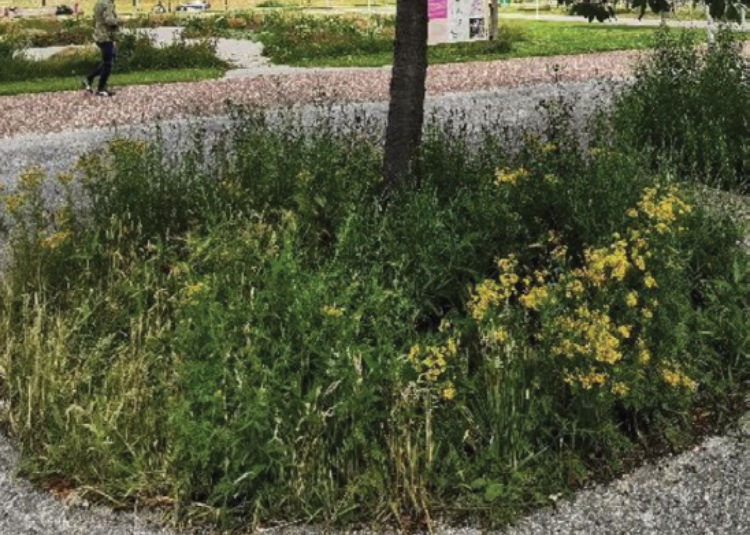
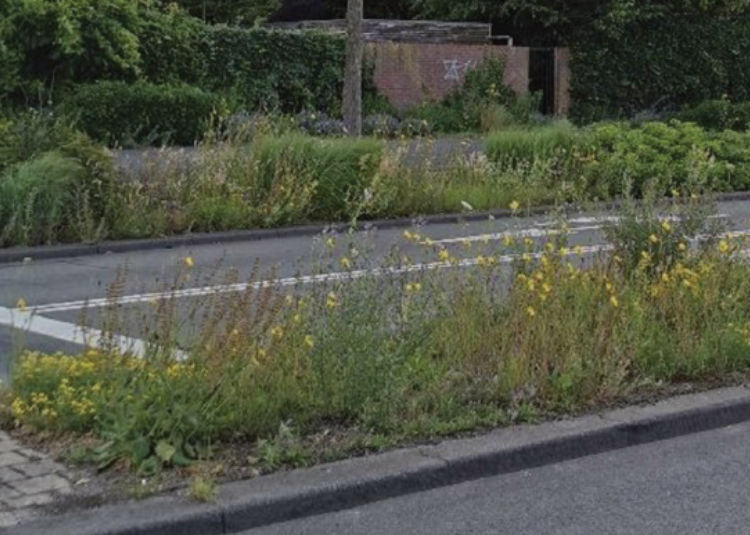
Some of the rain gardens that can be found in the city of Utrecht, the Netherlands.
Image Credits: [Mark Bryan Alivio], [2022]. Used with permission;
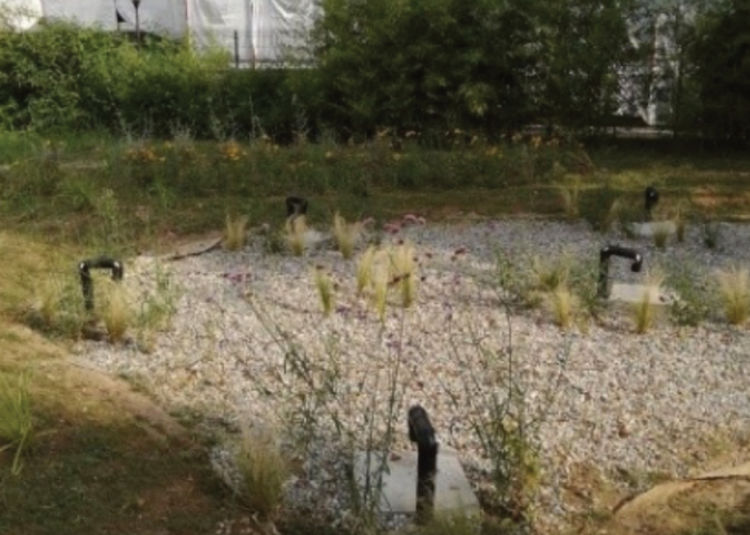
Rain garden to recover rainwater from the roof of the adjacent school.
Image Credit: [IRIDRA], [2024], Used with permission;
Why now, in autumn?
Autumn is one of the best times to plant. The soil is still warm, rainfall does the watering for you, and roots have the whole winter to establish before the summer heat. Autumn rains also reveal exactly where water flows and collects on your property.
Getting started in five steps:
- During the next rainfall, observe where water runs off the roof or the driveway.
- Choose a spot a few metres away from the building foundations, where water can easily reach it.
- Dig a shallow depression and loosen the soil, adding compost and sand if it is heavy clay.
- Plant native species that tolerate both wet and dry conditions, such as yellow flag iris, sedges, yarrow, marsh mallow or purple loosestrife.
- Cover the soil with mulch and let nature do the rest.
NATURE-DEMO: nature as infrastructure
Rain gardens are one of the nature-based solutions catalogued by NATURE-DEMO, a research and innovation project funded by the European Union under Horizon Europe. The project brings together 23 organisations from 14 countries to test how nature can protect roads, railways, energy networks and settlements against floods, droughts, landslides and wildfires.
Sources
Related
-
NATURE-DEMO Featured at Tag der Schiene 2026 by DZSF
On September 19–20, 2026, the German Centre for Rail Traffic Research at the Federal Railway Authority (DZSF) represented the NATURE-DEMO project during Tag der Schiene 2026 (Railway Day), a major public outreach event dedicated to the future of rail transport.
-
NATURE-DEMO Scientific Frameworks Shared at Erasmus+ CRESC Summer School in Ostrava
From August 24 to 28, 2026, the Faculty of Safety Engineering at VŠB – Technical University of Ostrava (Czech Republic) hosted the Erasmus+ Blended Intensive Programme (BIP) International Summer School on Climate-Resilient Critical Infrastructure (CRESC).
-
NATURE-DEMO Newsletter no. 9
Stay updated on how NATURE-DEMO is strengthening European infrastructure resilience against climate hazards. Explore our latest quarterly newsletters to discover key project milestones, field implementation updates across our demo sites, newly published scientific research, and upcoming events.
-
NATURE-DEMO Featured in ETR Journal: Nature-Based Solutions for Climate-Resilient Rail Infrastructure
The presentation highlighted how the catalogue can support the identification, selection, and implementation of NbS for climate resilience, sustainable infrastructure, and adaptation to natural hazards. It also provided an opportunity to discuss how NbS can be transferred into practical applications across different environments and communities.
-
NATURE-DEMO Research Highlighted at Sustainable Solid Waste Management Conference
The presentation highlighted how the catalogue can support the identification, selection, and implementation of NbS for climate resilience, sustainable infrastructure, and adaptation to natural hazards. It also provided an opportunity to discuss how NbS can be transferred into practical applications across different environments and communities.