
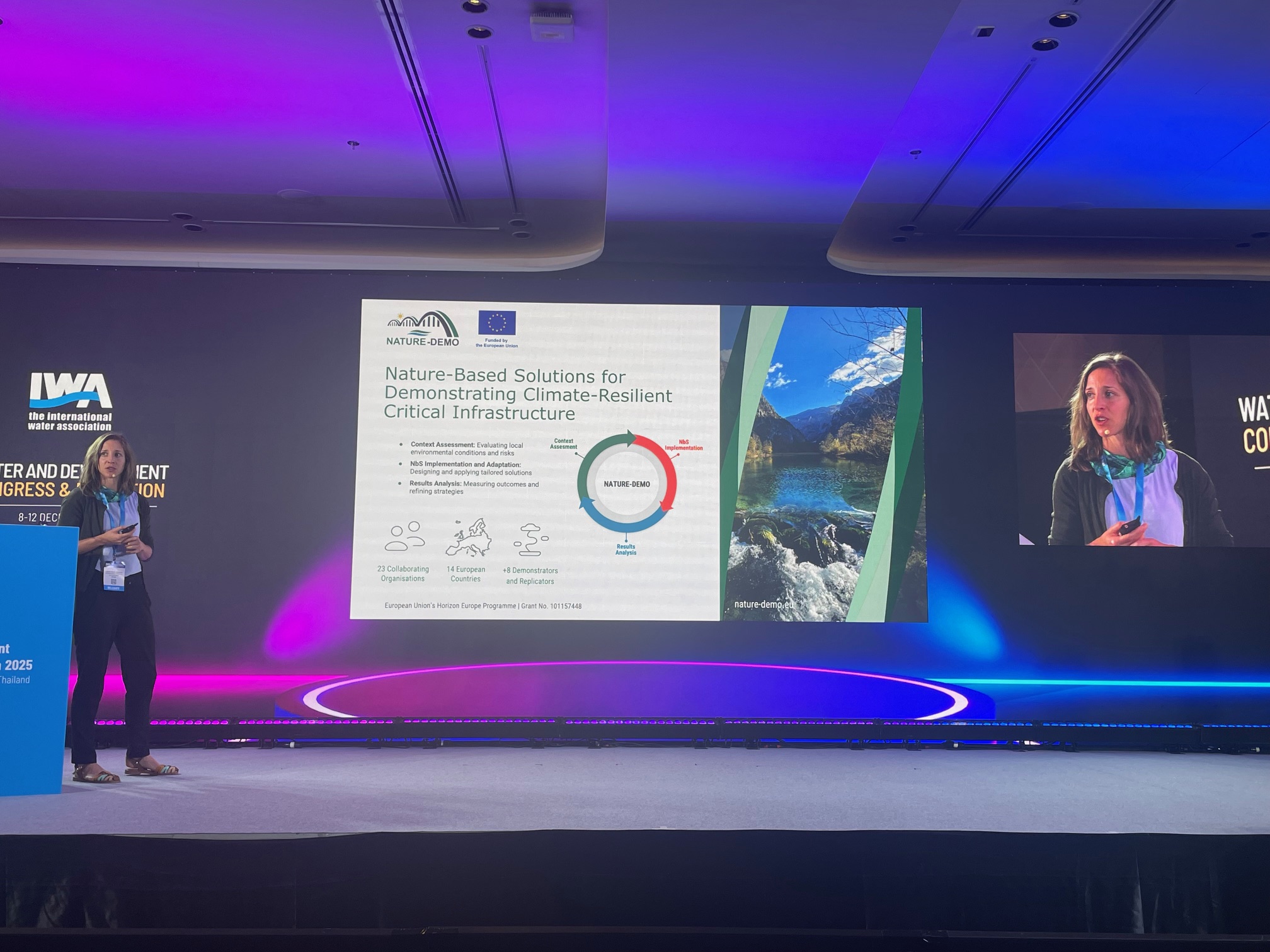
The NATURE-DEMO team contributed its expertise to the IWA Water and Development Congress & Exhibition | 8-12 December | Bangkok, Thailand. The project was represented by Lauren Machí Castañer, Maria Wirth - alchemia-nova research & innovation gemeinnützige GmbH and Maryam Imani - member of the NATURE-DEMO Advisory Board.
At the congress, we presented "Harnessing nature for infrastructure protection: Integrated spatial planning design with nature-based solutions in multi-hazard conditions" - Lauren Machí Castañer, Maria Wirth, E. Canga, E. H. Flaata, L. F. Seifert
The integrated planning framework is designed to support multi-stakeholder decision-making for climate-resilient critical infrastructure under multi-hazard conditions. This systemic approach integrates all key constraints and enabling factors—ranging from geomorphology and cascading risk pathways to institutional, spatial, and socio-economic conditions—into the earliest stages of planning and design.
By providing a clear, step-by-step methodology and decision-support tools, including an NbS risk matching matrix and site-specific design criteria, the framework enables practitioners to systematically identify, assess, and design Nature-Based Solutions for impact mitigation across various infrastructure types and risk contexts.
The presentation also served as an open call to practitioners and authorities facing similar challenges, particularly in regions lacking a systemic pre-feasibility methodology to guide effective impact mitigation and reduce the risk of critical infrastructure failure.
The significant interest from participants has already led to several requests for further engagement. We are now planning an initial round of information exchanges to further disseminate the framework and support its testing and large-scale application in diverse global contexts. This high level of interest—coming from water and wastewater utilities, international consultants, public actors, and researchers—confirms that the NATURE-DEMO planning framework responds to an urgent global demand, especially in regions where infrastructure is expanding rapidly and requires robust, nature-positive protection.

Related
-
NATURE-DEMO Newsletter no. 9
Stay updated on how NATURE-DEMO is strengthening European infrastructure resilience against climate hazards. Explore our latest quarterly newsletters to discover key project milestones, field implementation updates across our demo sites, newly published scientific research, and upcoming events.
-
NATURE-DEMO Featured in ETR Journal: Nature-Based Solutions for Climate-Resilient Rail Infrastructure
The presentation highlighted how the catalogue can support the identification, selection, and implementation of NbS for climate resilience, sustainable infrastructure, and adaptation to natural hazards. It also provided an opportunity to discuss how NbS can be transferred into practical applications across different environments and communities.
-
NATURE-DEMO Research Highlighted at Sustainable Solid Waste Management Conference
The presentation highlighted how the catalogue can support the identification, selection, and implementation of NbS for climate resilience, sustainable infrastructure, and adaptation to natural hazards. It also provided an opportunity to discuss how NbS can be transferred into practical applications across different environments and communities.
-
NATURE-DEMO Dissemination at ICONHIC 2026 in Greece
The presentation highlighted how the catalogue can support the identification, selection, and implementation of NbS for climate resilience, sustainable infrastructure, and adaptation to natural hazards. It also provided an opportunity to discuss how NbS can be transferred into practical applications across different environments and communities.
-
NATURE-DEMO NbS Catalogue Presented at the University of Huddersfield
The presentation highlighted how the catalogue can support the identification, selection, and implementation of NbS for climate resilience, sustainable infrastructure, and adaptation to natural hazards. It also provided an opportunity to discuss how NbS can be transferred into practical applications across different environments and communities.