
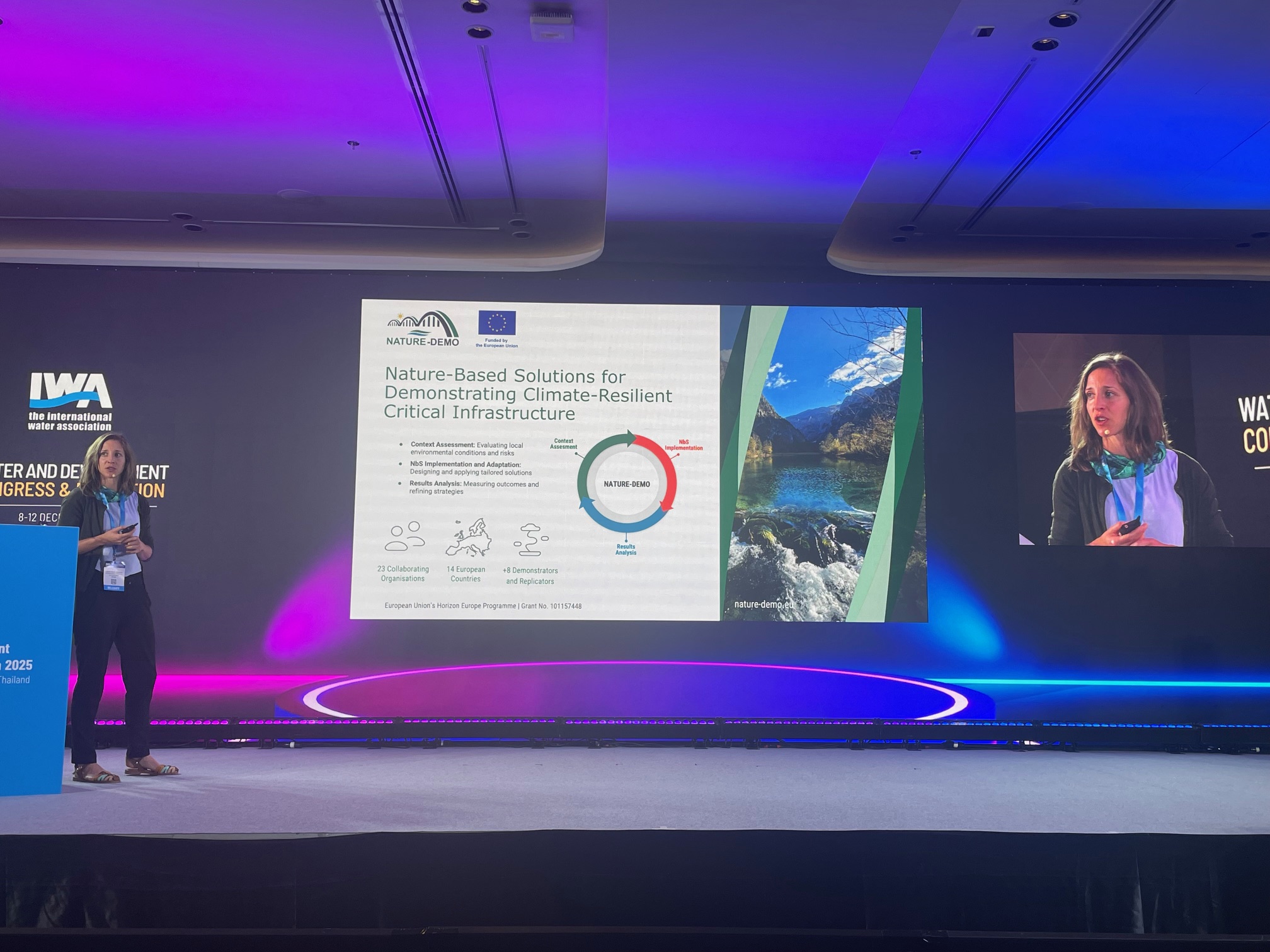
The NATURE-DEMO team contributed its expertise to the IWA Water and Development Congress & Exhibition | 8-12 December | Bangkok, Thailand. The project was represented by Lauren Machí Castañer, Maria Wirth - alchemia-nova research & innovation gemeinnützige GmbH and Maryam Imani - member of the NATURE-DEMO Advisory Board.
At the congress, we presented "Harnessing nature for infrastructure protection: Integrated spatial planning design with nature-based solutions in multi-hazard conditions" - Lauren Machí Castañer, Maria Wirth, E. Canga, E. H. Flaata, L. F. Seifert
The integrated planning framework is designed to support multi-stakeholder decision-making for climate-resilient critical infrastructure under multi-hazard conditions. This systemic approach integrates all key constraints and enabling factors—ranging from geomorphology and cascading risk pathways to institutional, spatial, and socio-economic conditions—into the earliest stages of planning and design.
By providing a clear, step-by-step methodology and decision-support tools, including an NbS risk matching matrix and site-specific design criteria, the framework enables practitioners to systematically identify, assess, and design Nature-Based Solutions for impact mitigation across various infrastructure types and risk contexts.
The presentation also served as an open call to practitioners and authorities facing similar challenges, particularly in regions lacking a systemic pre-feasibility methodology to guide effective impact mitigation and reduce the risk of critical infrastructure failure.
The significant interest from participants has already led to several requests for further engagement. We are now planning an initial round of information exchanges to further disseminate the framework and support its testing and large-scale application in diverse global contexts. This high level of interest—coming from water and wastewater utilities, international consultants, public actors, and researchers—confirms that the NATURE-DEMO planning framework responds to an urgent global demand, especially in regions where infrastructure is expanding rapidly and requires robust, nature-positive protection.

Related
-
Highlighting climate resilience: NATURE-DEMO’s presence at the International Civil Protection Conference
The NATURE-DEMO project was represented at the 24th International Conference Population Protection 2026 in Ostrava. This gathering served to present current trends and critical topics in the field of civil and population protection, highlighting the growing importance of Nature-Based Solutions (NbS) in modern safety frameworks.
-
NATURE-DEMO and DZSF: Showcasing Nature-Based Solutions at the DB InfraGO Conference
On January 27–28, 2026, the NATURE-DEMO project, represented by our partner DZSF (German Centre for Rail Traffic Research), participated in the second edition of the conference Fachtagung Umweltschutz in Projekten der DB InfraGO AG.
-
NATURE-DEMO goes to University: Inspiring the next generation of Flood Risk Managers
As part of the Erasmus Mundus "Flood Risk Management" Master Programme, students attending the "Socioeconomic Assessment of Flood Protection" course participated in an interactive lecture dedicated to the integration of Nature-based Solutions (NbS) into critical infrastructure.
-
Promoting Nature-Based Solutions and Sustainable Infrastructure in the ECE Region
A new publication—Promoting Nature-based Solutions and Sustainable Infrastructure in the ECE Region: Environmental and Health Co-benefits—offers a timely and practical guide to integrating nature into infrastructure planning.
-
NATURE-DEMO Newsletter no. 6
This edition covers: Telespazio UK WP2 contribution to Nature | Consortium Meeting, 19-21 November 2025, Vienna, Austria | NATURE-DEMO Project Highlights