
Every urban tree pays back more than it costs, often two to three times over. That is the conclusion of cost-benefit studies summarised in NATURE-DEMO's fact sheet on urban forests. As autumn tree-planting season reaches European cities, it is worth asking what a well-planned urban forest can do for the infrastructure and people around it.
What is an urban forest?
An urban forest is not just a large park. It is a deliberately designed network of trees, shrubs and ground cover across a city and its outskirts: along streets, in parks, on embankments, in school yards and in peri-urban green belts. Its purpose is to make the city more resilient to climate hazards while improving the quality of life of its residents.
Three elements make it work:
- the right species in the right places: native and climate-adapted trees, shrubs and ground cover, arranged in clusters or corridors, with attention to height, canopy cover and root spread;
- healthy root systems: deep roots improve infiltration and stabilise slopes, while fibrous roots aerate the soil and build organic matter;
- engineered slopes and soils: green embankments and improved substrates that retain water and reduce erosion and landslide risk.
Why it matters
- Cooler cities. Shade and evapotranspiration reduce heat during heatwaves.
- Less flooding. Tree canopies intercept rain, and roots increase infiltration and slow runoff.
- Cleaner air. Leaves trap particulate matter and absorb pollutants.
- Protected infrastructure. Urban forests shield roads and railways from wind, stabilise slopes near bridges and tunnels, and protect energy infrastructure from heat and sedimentation.
- Biodiversity. Trees create habitats and ecological corridors for birds, pollinators and other wildlife.
- Health and well-being. Green spaces reduce noise, encourage physical activity and improve mental health.
What does it cost, and what does it return?
Studies consistently find that urban trees deliver more value than they cost:
| Study | Annual cost per tree | Annual benefit per tree | Benefit-cost ratio |
|---|---|---|---|
| McPherson et al. (2005) | €12–60 | €29–82 | 1.26–2.84 |
| Morgenroth (2023), review | €38–55 | €62–274 | 1.35–6.69 (average 3.39) |
Tree size matters: large trees return about €3.93 for every euro invested, compared with €1.40 for small trees. And because benefits such as mental health, biodiversity and employment are rarely quantified, these figures are likely to underestimate the real value.
Evidence from practice
MillionTreesNYC, New York, USA. Launched in 2007 by the NYC Department of Parks & Recreation and the New York Restoration Project, the initiative set out to plant and care for one million trees in a decade. The goal was reached by 2015, two years early, with trees planted in parks, along streets, in schoolyards and on private land. The programme led to measurable improvements in air quality, surface temperatures and stormwater interception, with a special focus on under-served neighbourhoods.
Why now?
November is one of the best months to plant trees in European cities. Cool, moist soil allows roots to establish over winter, so young trees are ready to grow when spring arrives and better prepared for their first summer heat.
Sources
NATURE-DEMO: nature as infrastructure
Urban forests are one of the nature-based solutions catalogued by NATURE-DEMO, a research and innovation project funded by the European Union under Horizon Europe. The project brings together 23 organisations from 14 countries to test how nature can protect roads, railways, energy networks and settlements against floods, droughts, landslides and wildfires.
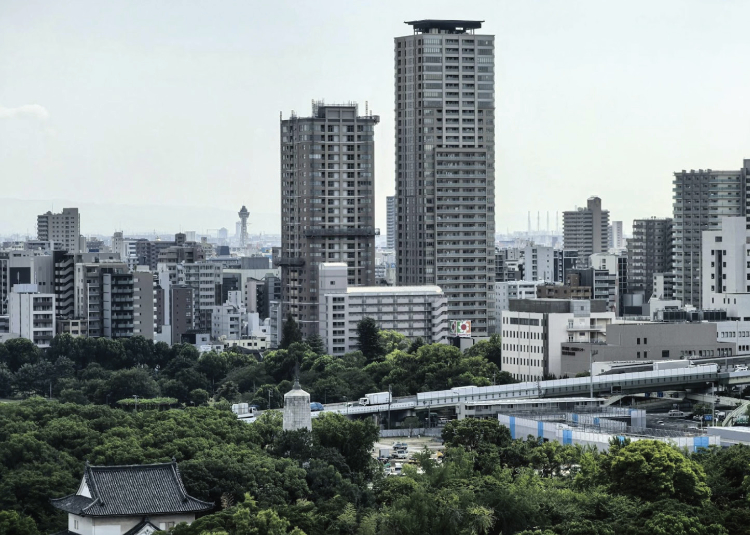
Bird’s Eye View of Urban Park and City Skyline - Osaka, Japan.
Image Credit: [Eileen Gao], [n.d] Free to use.
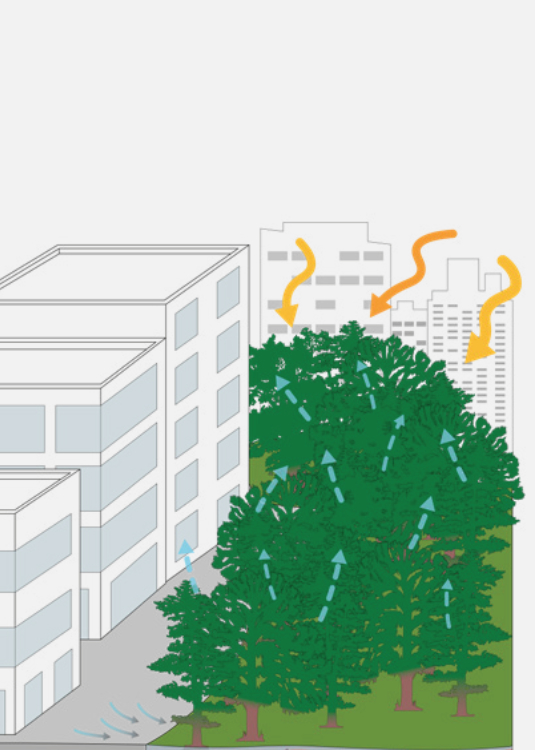
Schematic of Urban Forest, NbS family Urban Green Infrastructure.
Image Credit: [Alchemia-Nova Research and Innovation], [2025].
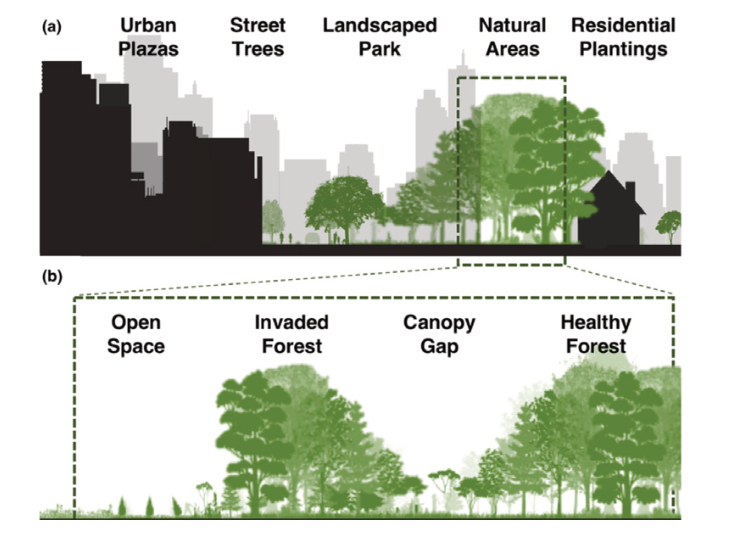
Sketch of Urban forest. (a) The urban forest encompasses a wide range of greenspaces, from planted sites to natural areas and woodlands; (b) In temperate, forested regions (e.g., the northeastern US), urban forested natural areas can be categorised
by forest condition to support targeted management approaches.
Image Credit: [Max R. Piana, Harvard University Graduate School of Design], [2021], Used with permission;
Related
-
Biodiverse hedgerows: living lines in the landscape
Bioswales are a linear rainwater run-off retention system designed as a shallow, gently sloping non-concrete channel (allowing for water infiltration). This system basically captures, retains and slowly releases the water run-off and direct rainwater into a conventional piping drainage system and/or the air (evapotranspiration) and soil (infiltration) media.
-
Cover crops: keeping soil alive through winter
Bioswales are a linear rainwater run-off retention system designed as a shallow, gently sloping non-concrete channel (allowing for water infiltration). This system basically captures, retains and slowly releases the water run-off and direct rainwater into a conventional piping drainage system and/or the air (evapotranspiration) and soil (infiltration) media.
-
Bioswales: green channels that slow the flow
Bioswales are a linear rainwater run-off retention system designed as a shallow, gently sloping non-concrete channel (allowing for water infiltration). This system basically captures, retains and slowly releases the water run-off and direct rainwater into a conventional piping drainage system and/or the air (evapotranspiration) and soil (infiltration) media.
-
Rain gardens: turning autumn rain into an ally
Autumn brings long spells of rain, and with them come flooded streets, blocked drains and overloaded sewers. In a city covered by asphalt, rooftops and paving, rainwater has nowhere to soak in, so it rushes towards the drainage network all at once. Rain gardens offer a simple, attractive and evidence-based alternative.